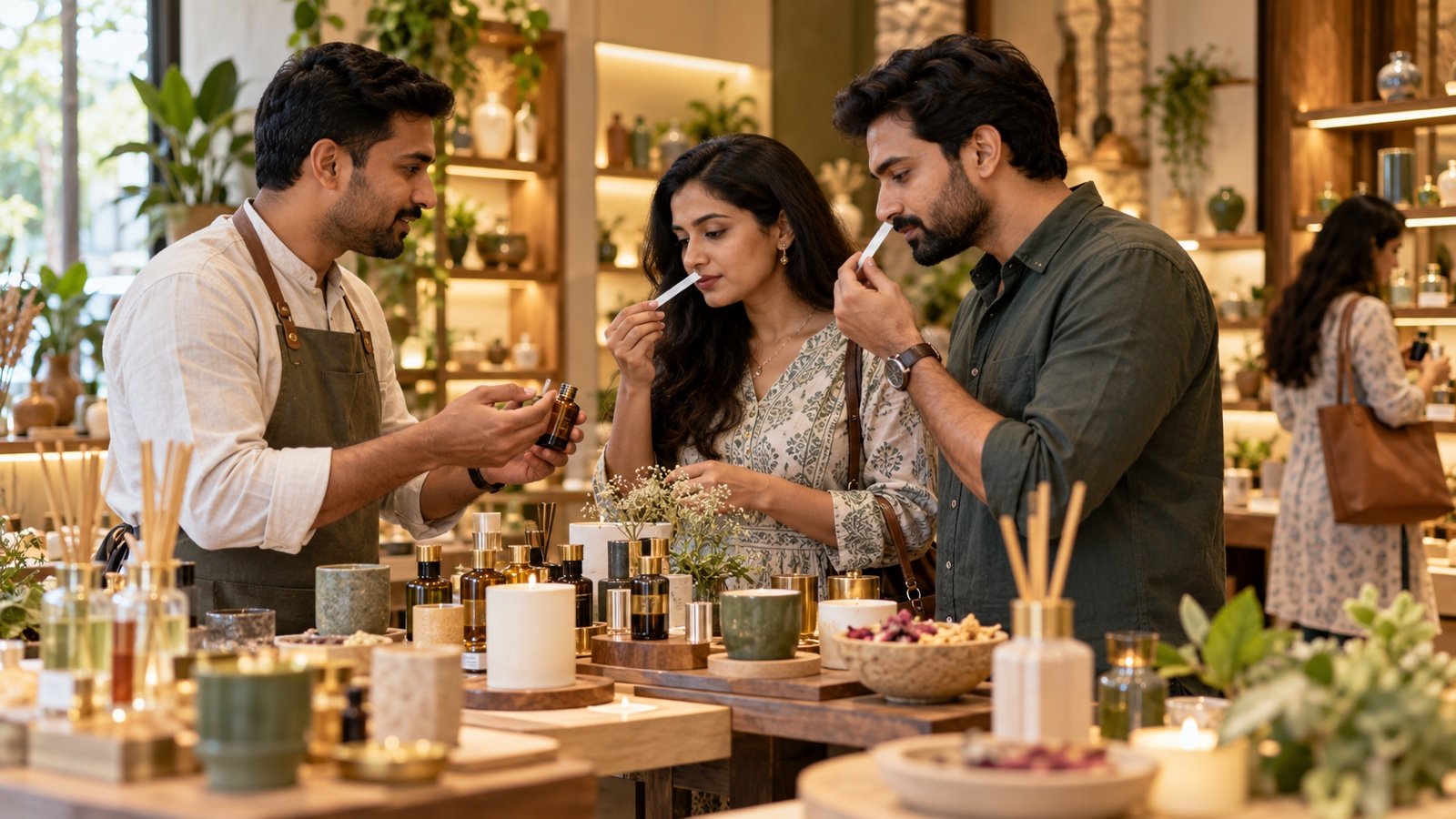
India’s retail market is moving in two directions at once: customers remain value-conscious, yet many selectively spend more for better quality, convenience, design, trust and memorable experiences. The Retailers Association of India’s October 2026 SANKET update, based on more than 70 million transactions across over 2,800 towns and cities, highlights continued retail-spend growth, strong Tier-3 performance and evolving consumption patterns. IBEF also describes a broader shift toward premium, sustainable and experience-based consumption.
For a franchise network, “premium” cannot mean an expensive flagship that ordinary outlets cannot reproduce. It must be a clear value proposition supported by assortment, service, environment, staff capability and unit economics. This audit helps founders and franchisees design an experience customers can understand and the network can deliver consistently. It is a strategic operating framework, not a promise that every category or city will support the same price or format.
1. Define the premium value in one sentence
State why the customer should pay more or choose the store instead of a marketplace or nearby alternative. The reason may be expert guidance, assured quality, customisation, speed, traceability, design, comfort or community. “Premium ambience” is not a proposition. The statement should identify the customer, the problem solved and the proof the outlet can consistently provide.
2. Separate premiumisation from luxury decoration
Premiumisation is an increase in perceived and delivered value, not automatically marble, gold lighting or a higher price. Audit product quality, usefulness, service confidence, convenience and after-sales support before adding expensive fit-out. An attractive store may create the first visit; only a better outcome creates trust and repeat purchase.
3. Choose the customer occasion to own
Map why the customer is shopping: routine replenishment, gifting, celebration, self-care, consultation, discovery, urgency or status. Design the experience around one or two priority occasions. A gifting store needs confident curation and delivery clarity; a wellness store needs safe guidance and repeat-use support. Serving every occasion equally usually creates a crowded assortment and a generic script.
4. Map the store journey from street to follow-up
Walk the path as a new customer: exterior, entrance, orientation, browsing, assistance, trial or demonstration, decision, payment, packaging and post-purchase contact. Note every moment of confusion or waiting. Photograph and time the journey with permission. Fix basic friction before adding events or technology; a workshop cannot compensate for unclear prices or a slow checkout.
Repeat the walk for a first-time visitor, a returning customer, a person in a hurry and a customer who needs accessibility support. Observe where staff attention becomes intrusive or disappears completely. Define what a good visit looks like even when no purchase happens—for example, the customer receives a correct recommendation, a sample or a useful next step and leaves willing to return.
5. Create one signature experience
Develop a repeatable moment customers associate with the brand: a diagnostic, tasting, styling session, live demonstration, customisation, guided trial or product-care lesson. Specify duration, tools, safety rules, staff language and next step. It should help the customer decide, not become theatre that pressures a purchase. Pilot it in several store types before making it a network standard.
6. Train staff as guides rather than greeters
Teach category knowledge, discovery questions, demonstration, comparison, objection handling and when to step back. Role-play customers with different budgets and familiarity. Do not reward only the highest bill value; include customer feedback, repeat rate, returns and process quality. Premium service feels informed and respectful, not aggressive or scripted.
7. Build an assortment ladder
Create clear entry, core and premium choices with meaningful differences in material, function, design, service or pack size. Keep a credible entry point so new customers can try the brand without feeling excluded. Remove duplicate SKUs that make comparison difficult. Staff should explain trade-offs honestly instead of treating the most expensive option as automatically best.
8. Use proof at the decision point
Place useful proof where a question arises: origin, materials, ingredients, warranty, care, comparison, certification or customer-use example. Keep claims specific and verifiable. Avoid invented awards, vague “number one” statements and review displays that hide the source. In categories involving health, finance or safety, have claims reviewed by the appropriate qualified professional.
9. Connect digital discovery with the physical visit
Customers may discover a product through short video, creator content, search, maps or WhatsApp before visiting. Keep store hours, inventory expectations, offers, address, appointment and service facts consistent. Use a booking, saved list, click-to-chat or store-specific page where useful. Do not make the customer repeat every preference after arriving; carry forward consented context into service.

10. Make local events commercially purposeful
Workshops, demonstrations, previews and community sessions should serve a defined audience and commercial goal. Record registrations, attendance, assisted purchases, later return and total cost. A small expert session that creates qualified repeat customers can be better than a crowded launch built only for photographs. Give each outlet an approved event playbook with room for local partnerships.
11. Design a Tier-2 and Tier-3 adaptation rule
RAI’s 2026 transaction view notes strong performance from Tier-3 cities, but that does not mean copying a metro flagship. Adapt store size, language, assortment depth, price ladder, local calendar and service format using demand evidence. Protect the core brand promise while allowing documented local variation. Test micro-market catchment and repeat behaviour before committing to a large-format lease.
12. Measure premium mix without hiding discount dependence
Track full-price sales, premium-tier mix, average transaction value, gross margin, attach rate, return or complaint rate and repeat purchase. Separate list-price growth from real product or service improvement. If premium products sell only under frequent discounts, the customer may be responding to the deal rather than valuing the proposition.
- Premium mix = sales from defined premium tier divided by total sales.
- Experience conversion = purchasers after a trial, consultation or event divided by participating customers.
- Repeat contribution = gross contribution from returning customers divided by total customer contribution.
- Full-price rate = units sold without a promotional markdown divided by total units sold.
13. Protect outlet economics
Calculate fit-out, training, demonstration material, samples, event cost, additional staff time, inventory holding and shrinkage. Compare these with incremental gross contribution, not only revenue. The format must leave adequate contribution after royalty, rent, staff, local marketing and working capital. A beautiful experience that lengthens service time without improving conversion or loyalty may weaken the franchisee.
Model the busy-hour capacity as well as an average day. A fifteen-minute consultation may work in a flagship but create a queue in a compact high-street outlet. Test appointments, express assistance and self-guided proof so different customers can choose the depth they need. Include replenishment and cleaning time for samples or demonstration equipment in labour planning.
14. Standardise the non-negotiables
Define the experience elements every outlet must deliver: opening readiness, display logic, greeting boundary, diagnostic or demonstration, product truth, checkout, packaging, complaint path and after-sales follow-up. Use observation-based audits and coaching rather than a photo checklist alone. A franchise standard should describe the customer outcome and the evidence of delivery.
15. Give franchisees a local learning loop
Let outlets record frequently requested products, objections, event questions, lost-sale reasons and local competitors. Review the signals centrally each month and return decisions to the network. Franchisees should know which suggestions are being tested, adopted or rejected. This converts local knowledge into system improvement without allowing uncontrolled claims or brand drift.
16. Run a 60-day store pilot
Days 1–10: baseline traffic, conversion, margin, returns and customer feedback. Days 11–25: introduce one signature experience and train the team. Days 26–40: refine the script, proof and assortment using observed questions. Days 41–60: test one local event or digital-to-store journey, then compare full economics with the baseline. Keep unrelated price and media changes limited so the result remains interpretable.
17. Use a scale, adapt or stop scorecard
Scale when the experience is understood by customers, teachable to staff, reproducible across outlet types and supported by contribution and repeat behaviour. Adapt when the proposition works but format, duration or assortment needs local adjustment. Stop when results depend on heavy discounting, unverified claims, founder-only performance or capital expenditure that franchise unit economics cannot recover.
Key takeaways
Put the framework into action
- Premiumisation means delivering a clearer customer outcome through quality, guidance, convenience or experience—not simply raising price or spending more on interiors.
- Build one signature experience, an honest assortment ladder and consistent digital-to-store information before adding multiple events or technologies.
- Scale only when the experience is teachable across outlets and improves contribution, full-price sales, customer outcomes and repeat behaviour.
Research sources
Sources & further reading
This article provides general business education, not legal, tax or financial advice. Adapt the framework to your market and consult qualified professionals where required.