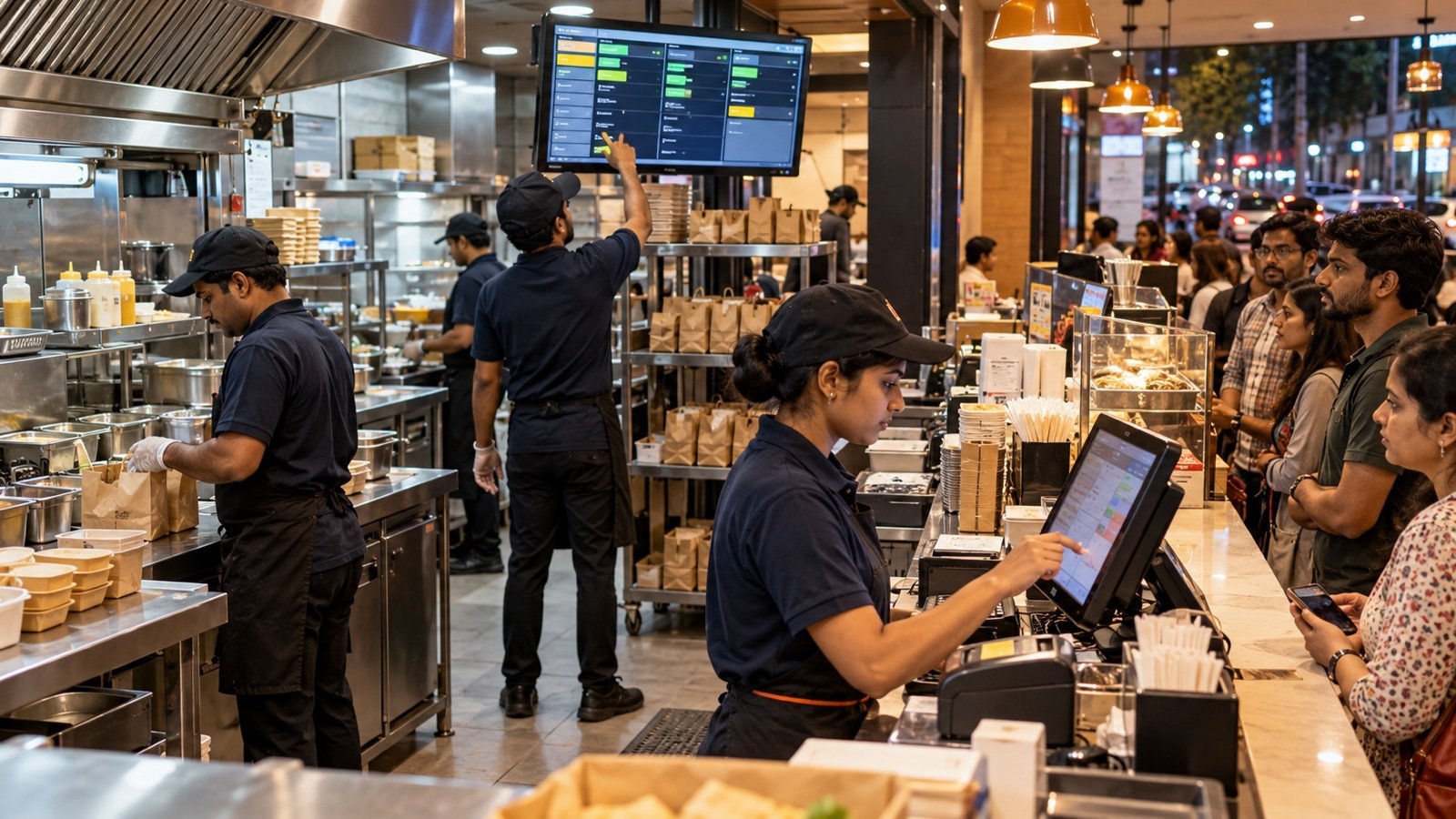
Technology has become a major franchise-growth priority in 2026, but many networks still operate through separate billing software, spreadsheets, WhatsApp groups and delayed outlet reports. Grant Thornton Bharat’s research on India’s expanding food-service markets found that only 24% of surveyed operators had implemented a full operational system spanning POS, ERP, CRM and kitchen automation. The lesson extends beyond restaurants: expansion becomes fragile when sales, stock, customers, training and support do not share reliable data.
A franchise tech stack is not a shopping list of fashionable apps. It is an operating architecture that defines where a transaction begins, which system owns each record, how outlets work during an internet failure, who can change data and what the franchisor and franchisee can see. This guide helps Indian franchise brands design a practical stack in phases. Product, tax, privacy, payment and sector requirements vary, so confirm them with qualified specialists for the actual business.
1. Map the operating process before choosing software
Draw the journey from enquiry or order through fulfilment, payment, stock movement, customer service, accounting and royalty reporting. Mark every manual re-entry and approval. Interview a high-performing outlet and a struggling outlet. Software selected without this map often digitises an exception while leaving the real workflow in spreadsheets.
2. Assign one system of record for every object
Decide which platform owns product codes, prices, outlet IDs, customer consent, staff IDs, suppliers, stock, invoices, tickets and training completion. Other tools may display or enrich the data, but they should not create conflicting masters. Publish a short data dictionary so “net sales”, “active customer” and “wastage” mean the same thing across the network.
3. Make POS or order capture the transactional core
The POS should record every sale, discount, tax, payment type, return, cancellation, channel and operator. For services, the equivalent may be a booking or job-management system. Test speed, receipt rules, offline behaviour, refunds, device support and multi-outlet controls. A POS that cannot export clean line-level data forces the rest of the stack to guess.
4. Connect online, marketplace and walk-in orders
Map orders from the brand website, app, delivery marketplace, phone, social messaging and counter into one controlled order flow where practical. Keep the original channel and fees visible. Avoid creating a second manual bill only to update stock. Reconcile marketplace settlements, refunds and commissions against the actual order ID rather than a monthly total.
5. Link inventory to recipes or service consumption
For food and retail, connect sold items to ingredients, components, packaging or finished goods. For services, track consumables, parts and billable hours. Define unit conversions, yield, wastage, transfers, expiry and stock counts. The theoretical stock from the system should be compared with physical stock; the variance is an operational question, not merely an accounting adjustment.
6. Build procurement and supplier controls
Use approved item and supplier lists, reorder levels, purchase requests, approvals, goods receipt and discrepancy records. Record batch or serial information where the category requires it. Give outlets a documented emergency-purchase path instead of forcing off-system buying. Central visibility should help negotiate and forecast without hiding local supply failures.
7. Use CRM for permissioned customer relationships
Unify customer identity carefully across POS, bookings, website, loyalty and support. Record the source and scope of consent, preferred channel and opt-out status. Avoid uploading uncontrolled personal contact lists into every tool. Segment by real behaviour—visit frequency, category, lifecycle or service need—rather than by intrusive assumptions.
8. Connect loyalty to margin, not only visits
A loyalty programme should track reward liability, redemption, repeat rate, average contribution and cross-outlet rules. Test what happens when a customer earns at one franchise and redeems at another, including who funds the benefit. Prevent duplicate accounts and staff misuse. A popular offer can still destroy value when discount and reward costs are reported separately.
9. Automate royalty and marketing-fee reconciliation
Define the royalty base in the agreement and system: gross sales, permitted deductions, tax treatment, returns, discounts, platform orders and timing. Produce a transparent monthly statement that both parties can trace to transaction records. Flag exceptions for review instead of allowing manual spreadsheet formulas to become the source of recurring disputes.
10. Put SOPs and learning inside the workflow
Use a learning or knowledge system for role-based onboarding, short process videos, checklists, assessments and version control. Link critical tasks to the current SOP rather than sending PDFs through chat groups. Record acknowledgement and competence separately; completing a video does not prove that a team member can perform the process during a rush.

11. Create a ticketing path for outlet support
Replace scattered calls with categories for technology, supply, maintenance, marketing, finance, HR and customer escalation. Capture outlet, severity, owner, promised response and resolution evidence. Define what counts as an emergency and when it escalates. Analyse repeated tickets to find a broken process rather than celebrating a high closure count.
12. Standardise audits with evidence
Build digital opening, closing, hygiene, brand, stock and service audits with time, outlet and reviewer records. Require photographs only where useful and lawful. Separate self-checks from independent audits. Corrective actions need an owner and due date; a score without closure evidence can turn compliance into theatre.
13. Design the outlet dashboard around decisions
Show a small set of comparable metrics: net sales, transactions, average order value, contribution, labour, stock variance, wastage, refunds, customer rating, service time, repeat rate and open critical tickets as applicable. Include target, prior period and network median. A dashboard should lead to a question and action, not display 60 charts nobody owns.
14. Give franchisor and franchisee clear visibility
Document which party can see transaction, customer, staff, financial and benchmarking data. Give franchisees access to the records needed to operate and reconcile their business. Limit personal data and network-wide comparisons to legitimate roles. The agreement, privacy notice and actual system permissions should not contradict one another.
15. Prepare for internet and device failure
Test offline billing or booking, queue recovery, payment fallback, local printing, device replacement and data synchronisation. Define which actions are blocked offline and how duplicates are prevented when connectivity returns. Keep a short outlet runbook with support contacts and recovery steps; a cloud-first system still needs a plan for a broken router or power supply.
16. Control access and change history
Use individual accounts, role-based permissions, strong authentication where supported and prompt deactivation when staff leave. Restrict price changes, refunds, stock adjustments and exports. Keep logs for sensitive actions and review unusual patterns. Do not share one administrator password across all outlets or vendors.
Security, privacy, tax and sector obligations depend on the systems and data involved. Obtain qualified technical and legal advice for the actual implementation.
17. Evaluate integrations before features
For every tool, ask whether it has documented APIs or reliable connectors, export formats, unique IDs, update frequency, failure alerts and ownership of integration support. Request a real data demonstration, not only a slide. Estimate the cost of maintenance when one vendor changes a field or authentication method. Manual CSV exchange can be acceptable in phase one if ownership and reconciliation are explicit.
18. Test vendors with a scored proof of concept
Choose two or three representative outlets and real use cases. Score speed, staff learning, data accuracy, offline recovery, reports, support, integration, permissions, total cost and exit capability. Include a busy period and month-end close. Do not let the vendor’s demonstration environment substitute for an outlet pilot with real constraints.
19. Roll out in three practical phases
Phase one should establish outlet IDs, product masters, POS or order capture, payments and reliable sales exports. Phase two adds inventory, procurement, CRM, loyalty, royalty and support. Phase three introduces forecasting, advanced automation and AI only after data quality and process ownership are stable. CII’s 2026 enterprise research similarly highlights data readiness and governance as prerequisites for value from AI-enabled ERP.
20. Measure adoption and business impact
Track billing coverage, inventory-count completion, data latency, reconciliation differences, ticket resolution, training completion, stock variance and manager use—not only licences purchased. Compare outlet economics before and after while noting other changes. Technology is working when the network makes faster, more consistent decisions and reduces avoidable leakage, not when every team has another login.
21. Use a go-live checklist
Before rollout, confirm the master data, tax and price configuration, outlet roles, device inventory, connectivity, backup, staff training, support SLA, consent language, export, reconciliation, incident path and vendor-exit plan. Freeze non-essential changes around launch. Keep a daily issue room for the first week and a documented 30-day review before expanding to the full network.
Key takeaways
Put the framework into action
- Start with operating processes and systems of record, then connect POS, inventory, CRM, finance, learning and support in phases.
- Design for offline recovery, permissions, transparent franchisee visibility and traceable royalty calculations from the beginning.
- Measure adoption, reconciliation and outlet business outcomes—not the number of software licences or dashboard charts.
Research sources
Sources & further reading
This article provides general business education, not legal, tax or financial advice. Adapt the framework to your market and consult qualified professionals where required.